 Nederlands




Wenzhou Gangyuan Electronics Co.,Ltd.
Nominale stroom en spanning van een schakelaar uitgelegd: Kun je een schakelaar gebruiken voor een hogere belasting?
Wat betekenen de nominale stroomsterkte en spanning voor een schakelaar? Kan deze worden gebruikt voor hogere belastingen?
Als u een apparaat of een elektronisch apparaat ontwerpt, bent u waarschijnlijk wel eens specificaties zoals 5A 125V AC of 3A 250V AC tegengekomen op het specificatieblad van een schakelaar.
Maar wat betekenen deze cijfers nu eigenlijk? En nog belangrijker: Kun je een schakelaar gebruiken met een hogere belasting dan waarvoor hij is ontworpen?
In dit artikel leggen we de basisprincipes van de elektrische waarden van schakelaars uit en waarom het overschrijden ervan nooit een goed idee is.
1. Wat is de nominale stroomsterkte?
De nominale stroomsterkte (meestal in ampère, A) is de
maximale continue stroom
dat een schakelaar onder bepaalde omstandigheden veilig kan functioneren en onderbrekingen kan verwerken.
2. Wat is de nominale spanning?
De nominale spanning (in volt, V) is de
maximale spanning
De schakelaar kan de stroomtoevoer via de open contacten weerstaan en de stroomtoevoer veilig onderbreken bij het openen.
3. Kan ik een schakelaar gebruiken met een hogere belasting (stroom of spanning) dan waarvoor deze is bedoeld?
Nee. Overschrijd nooit tegelijkertijd de nominale stroomsterkte en spanning.
Zelfs het overschrijden van één parameter is riskant. Dit is waarom:
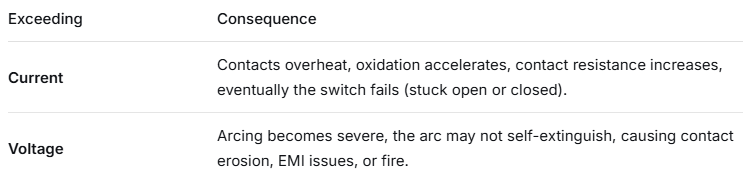
Praktisch voorbeeld
:
Een schakelaar met een nominale stroomsterkte van 3A bij 250V wisselstroom kan niet worden gebruikt voor een belasting van 10A bij 250V wisselstroom; de contacten zullen snel doorbranden.
Het kan ook niet worden gebruikt op 5A 125V wisselstroom, omdat de stroomsterkte dan nog steeds boven de 3A ligt.
4. Wat als we een schakelaar gebruiken met een lagere spanning maar een hogere stroomsterkte?
Nog steeds niet toegestaan
.
De nominale stroomsterkte is een absolute limiet, ongeacht de spanning. Zelfs als u de spanning verlaagt, zal dezelfde stroomsterkte dezelfde warmteontwikkeling in de contactweerstand veroorzaken.
Voorbeeld:
Een schakelaar met een nominale waarde van 1A 250V AC kan geen 2A 12V DC aan. De contactweerstand en de warmteontwikkeling blijven gelijk.
5. Bestaat er een richtlijn voor "ratingverlaging"?
Voor
betrouwbaarheidskritische toepassingen
(medisch, automobiel, industriële besturing), gebruiken ingenieurs vaak een
veiligheidsmarge
– een schakelaar gebruiken met niet meer dan 70-80% van de nominale stroom en spanning.
Voorbeeld:
Als uw belasting 2A 125V AC is, kies dan een schakelaar met een nominale waarde van minimaal 3A 125V AC of hoger.
Door de vermogensreductie wordt de levensduur van de schakelaar verlengd en het risico op storingen verminderd.
6. Samenvatting – Snelle checklist
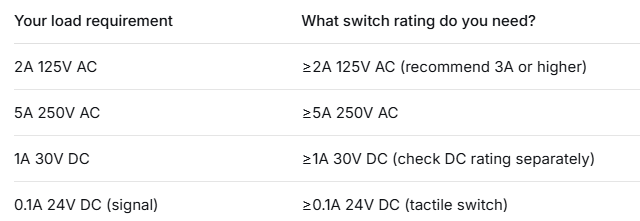
Gouden regel: Gebruik altijd een schakelaar met een classificatie. gelijk aan of hoger dan De maximale belasting die u wilt schakelen. Ga er nooit vanuit dat een schakelaar meer aankan, alleen omdat hij er "gelijk" uitziet.
Hulp nodig bij het kiezen van de juiste schakelaar?
Wij zijn een
directe fabrikant
van tactiele schakelaars, microschakelaars en zelfvergrendelende/niet-vergrendelende schakelaars.
Als u niet zeker bent van de spanning/stroomvereisten, kunt u ons eenvoudigweg uw belastingsspecificaties toesturen (spanning, stroom, wisselstroom/gelijkstroom, belastingstype: resistief, inductief of capacitief).
Onze technici adviseren u graag over de meest geschikte schakelaar voor uw toepassing.
Voor Invragen over onze producten of prijslijst, laat ons alsjeblieft en we zullen binnen 24 uur contact opnemen.


 R.m 25D1, Block C, No 2070, Keji Dianzi Building, Shennan Zhong Rd., Futian Dist., Shenzhen, China
 0577-62573066
auteursrechten © 2026 Wenzhou Gangyuan Electronics Co., Ltd.. Alle rechten voorbehouden. Macht

IPv6-netwerk ondersteund


